1.2.6 Spatial Thinking — section quiz
Unit 1 · Introduction to Geography · Lesson 1.2 · covers Everything in 1.2.0 – 1.2.5
Unit 1 · Introduction to Geography · Lesson 1.2 · covers Everything in 1.2.0 – 1.2.5
Lesson 1.2 jumps straight into words like norms, society and density as if everyone was taught them years ago. Plenty of schools never get to them. Open this if any of those words feel slippery.
Here's the good news about this whole section: there is no math, nothing to memorize about countries, and no map skills. It's 22 labels for things you already understand from being a person in the world. You already know that different families have different rules, that moving somewhere new feels weird, and that a crowded room is different from a big empty one. The course just gives those things formal names. A lot of schools rush past this vocabulary or skip it entirely, so if it feels unfamiliar, that's about what you were taught, not about you.
If you thought geography meant memorising rivers and state capitals, that's the other half of the subject. This unit is about people — where they are, how they're grouped, what they believe, and how they change. That's why almost every term here is really a term about people.
Think about going to a friend's house for the first time. Do they take their shoes off? Does everyone eat together at the table, or grab food whenever? Is it loud or quiet? Nobody hands you a rulebook, but there is one — and you figure it out by watching. That's culture. "Society" is just the big version of the same thing.
This pair trips up almost everyone, so get it once and it's yours. Value: "being late is disrespectful." That's a belief about right and wrong. Norm: "you text someone if you're going to be more than five minutes late." That's the actual behavior that enforces the belief. Value = the idea. Norm = the habit.
Ten people in an elevator is crowded. Ten thousand people in a football stadium is not. The stadium has a way bigger population; the elevator has a way bigger density. Density always answers "how many people per some amount of space" — per square mile, per room, per whatever. Any time you see the word per, you're looking at a density.
A flat list of 22 things is genuinely hard to hold. The walkthrough page groups them: space & maps (3), culture and its parts (5), groups within a culture (4), how cultures change (6), and people & numbers (4). Learn one clump at a time and the list stops feeling enormous.
What is Human Geography? — Crash Course Geography #28 — Ten minutes on what this branch of geography even is. Good for the big picture; it goes wider than your lesson, so don't worry about the parts you don't recognize.
Your town has 40,000 people. The next town over has 8,000 people but everyone lives packed into a few blocks. Which town has the bigger population, and which has the bigger population density?
Your town has the bigger population (40,000 people — just more people). The next town has the bigger population density (fewer people, but packed into far less space). This is exactly the China/Israel comparison your lesson uses.
Got it now? Scroll back up and re-read the section — it should land differently.
These are the course's own definitions, straight from the key-term list and the study sheets. Learn one clump at a time rather than treating it as a list of 22.
| spatial thinking | Thinking about the world based on the space that objects and people fill. |
| mental map | An internal rendering of an individual's known world. |
| cartographer | Mapmaker. |
| culture | The behaviors and beliefs of a group of people. |
| values | A culture's ideas about what is right and wrong. |
| social norms | Established standards of behavior that are maintained by society. |
| symbols | Objects or images that communicate ideas — anything carrying a meaning people of the same culture share. |
| language | A system of symbols that allows people to communicate with one another. |
| dominant culture | The beliefs and behaviors of the majority of people; also called "the mainstream." |
| deviance | Departure from established norms. |
| counterculture | A group of people who are systematically opposed to the dominant culture. |
| subculture | A group of people who ignore some of the larger society's values in order to focus on what they find important. |
| acculturation | The process of adopting the social patterns of another group. |
| culture shock | Surprise, disorientation, confusion, and anxiety that accompany the experience of operating within an entirely different cultural environment than one's own. |
| hierarchy | A system that ranks and organizes people into subordinate and superior positions. |
| innovation | The process whereby new ideas and ways of doing things are introduced and accepted by the members of a group. |
| diffusion | The process of cultural traits spreading from one group to another — usually through migration, trade, or communication. |
| diversity | Differences in cultures, beliefs, or behaviors — both between cultures and within one culture. |
| population | The inhabitants of a particular area. |
| population density | The number of people per unit of area, for example people per square mile. |
| demography | The study of human population. |
| demographics | Definable characteristics of a population — the information collected about people living in particular areas. |
Lesson 1.2.0 – 1.2.1 p1
The lesson opens with a joke you might have skimmed past: "Space — the final frontier." It's not talking about outer space. In geography, space means the ordinary physical world people occupy — your bedroom, your street, your town.
Spatial thinking is thinking about the world based on the space that objects and people fill. The lesson's example: you can walk to the bathroom in the dark without hitting anything, because your mind holds a map of your house. But the moment you have to explain that route to a friend, you're doing the hard part of spatial thinking — making your private knowledge of space usable by somebody else.
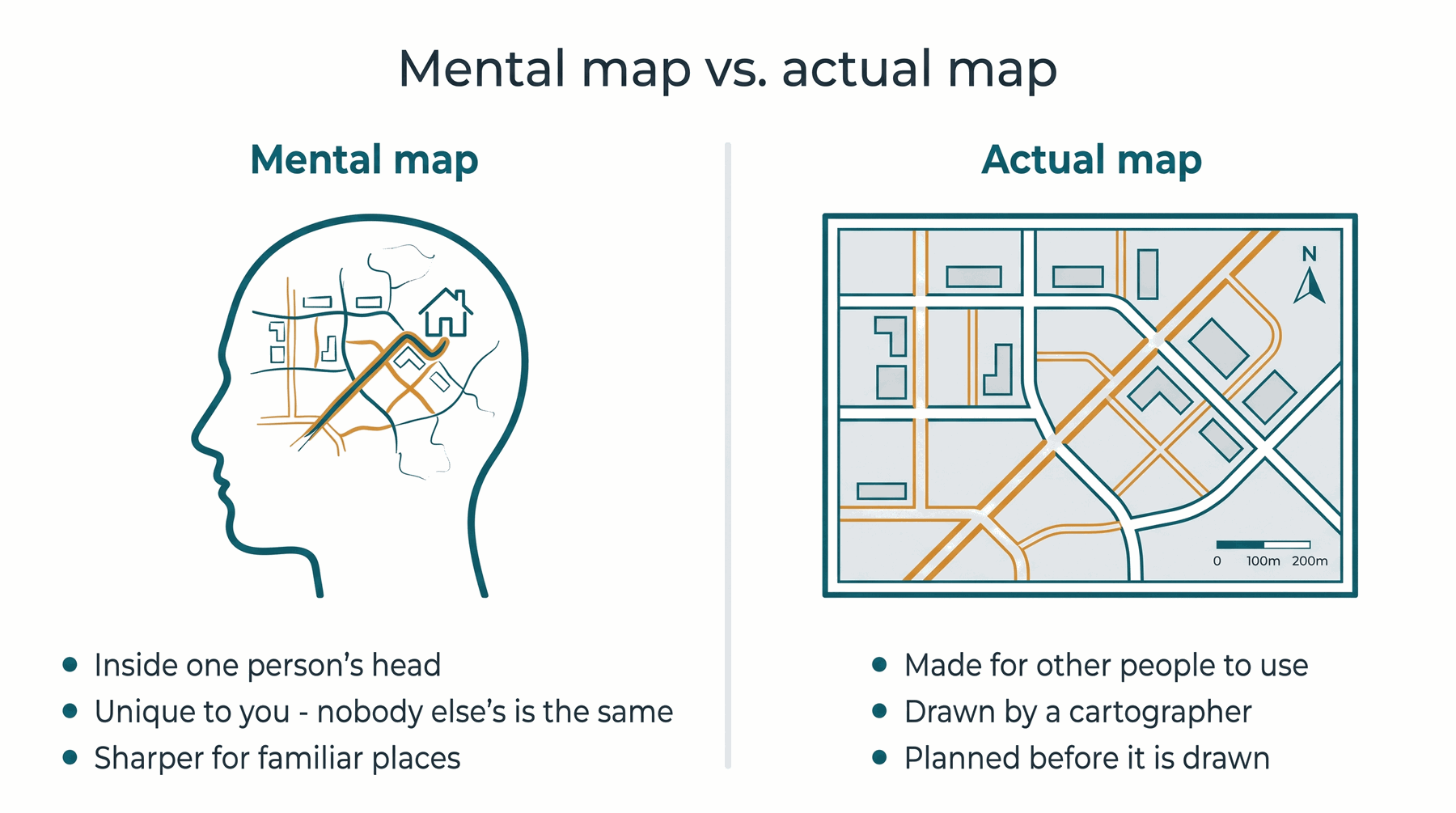
That "private knowledge → shared with others" idea is the spine of the whole lesson. Mental map is the private version. An actual map is the shared version.
Lesson 1.2.1 p2–3
A mental map is an internal rendering of an individual's known world. Yours might hold where the remote control is and how to reach the nearest pizza place.
Three things the lesson says about mental maps that are easy to test:
• They're unique to each person. Ask two students for directions to the same school and you'll get two different routes and different landmarks.
• They're not always pictures. Some people's are visual, some verbal — you might describe your bedroom in words rather than see it.
• The more familiar the space, the better the map.
And then the one that sounds like a throwaway sentence but is exactly the kind of thing a quiz picks up:
Click any diagram to open it full-screen.
"Mental map" sounds technical, but you use one every single day without noticing.
Without looking, picture the route from your bedroom to the kitchen. Where do you turn? What do you pass? You just read your mental map. It's not a picture you drew — it's knowledge of space stored in your head.
If you and a friend both gave someone directions to the same place, you'd mention different landmarks. Neither of you is wrong. That's the point the lesson is making: a mental map is built out of your experience, so no two are the same.
People's mental maps are sharpest for places they know well, and studies show people also rate those familiar places more positively. So "clearer" and "better" travel together. If a quiz option says people see familiar places as clearer and better, that's the one.
Why would two students at the same school give different directions to it?
Because mental maps are unique to each individual — each one is built from that person's own experience of the space, so they notice and remember different routes and landmarks.
Got it now? Scroll back up and re-read the section — it should land differently.
Lesson 1.2.1 p4–5, 1.2.2
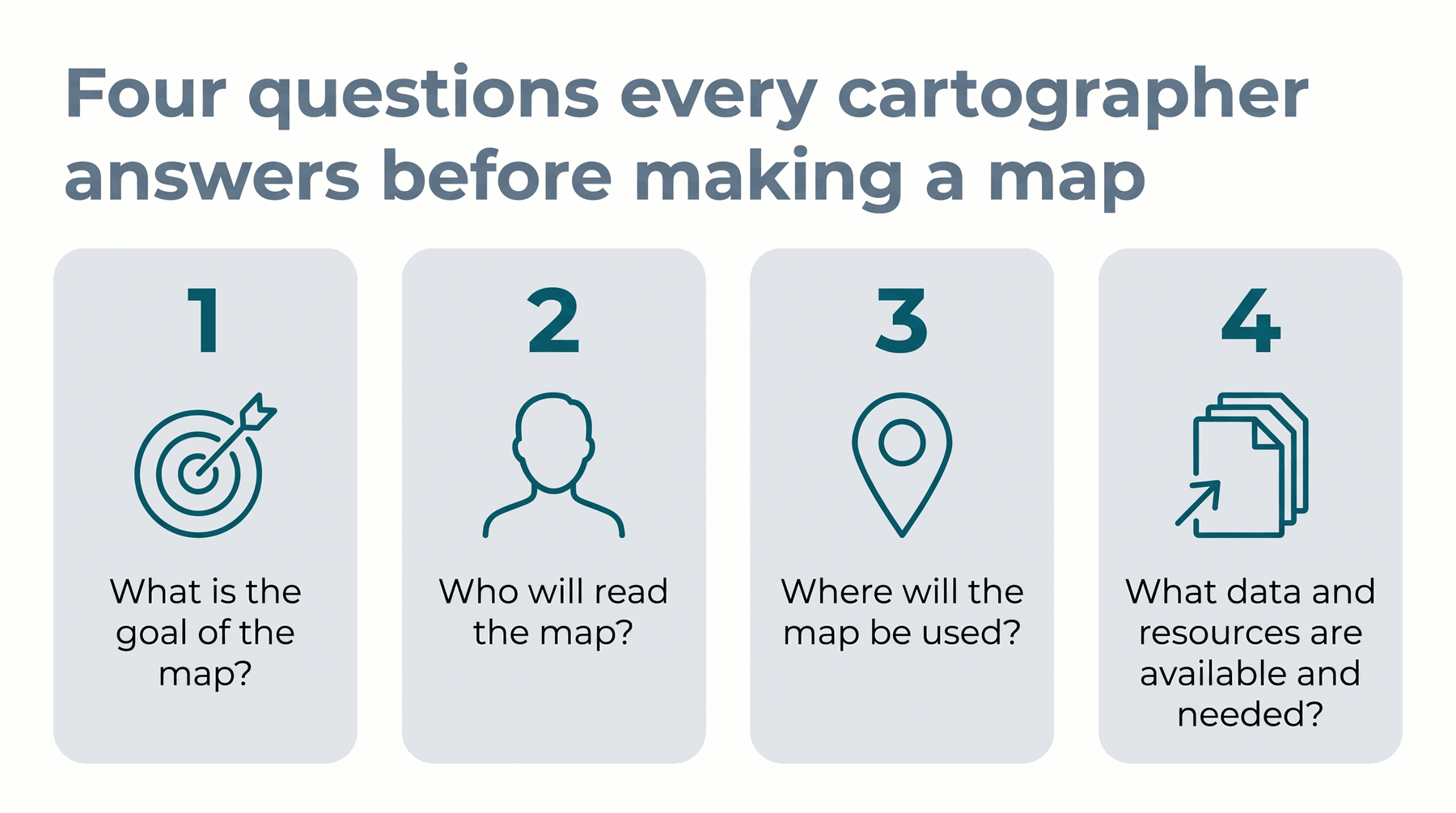
Representing space to yourself is a mental map. Representing it to someone else, especially someone who's never been there, is hard enough that it's a profession. A cartographer is simply a mapmaker.
Your study sheet asks: "List the four questions that mapmakers ask themselves before creating a map." In 1.2.1 those four questions were hidden inside a blackboard interactive — but they're written out in plain text in the 1.2.2 Your Mental Map assignment, and they're the same four questions that assignment made you answer about your own map.
Click any diagram to open it full-screen.
Lesson 1.2.3 p1–3
Culture is the behaviors and beliefs of a group of people. The lesson's way in is the formal dinner in Afghanistan — unfamiliar food, unfamiliar clothing, and rules you don't know (which hand? is there a dipping order?). Then it brings it closer to home: a new student working out how people act at a new school is reading a culture too.
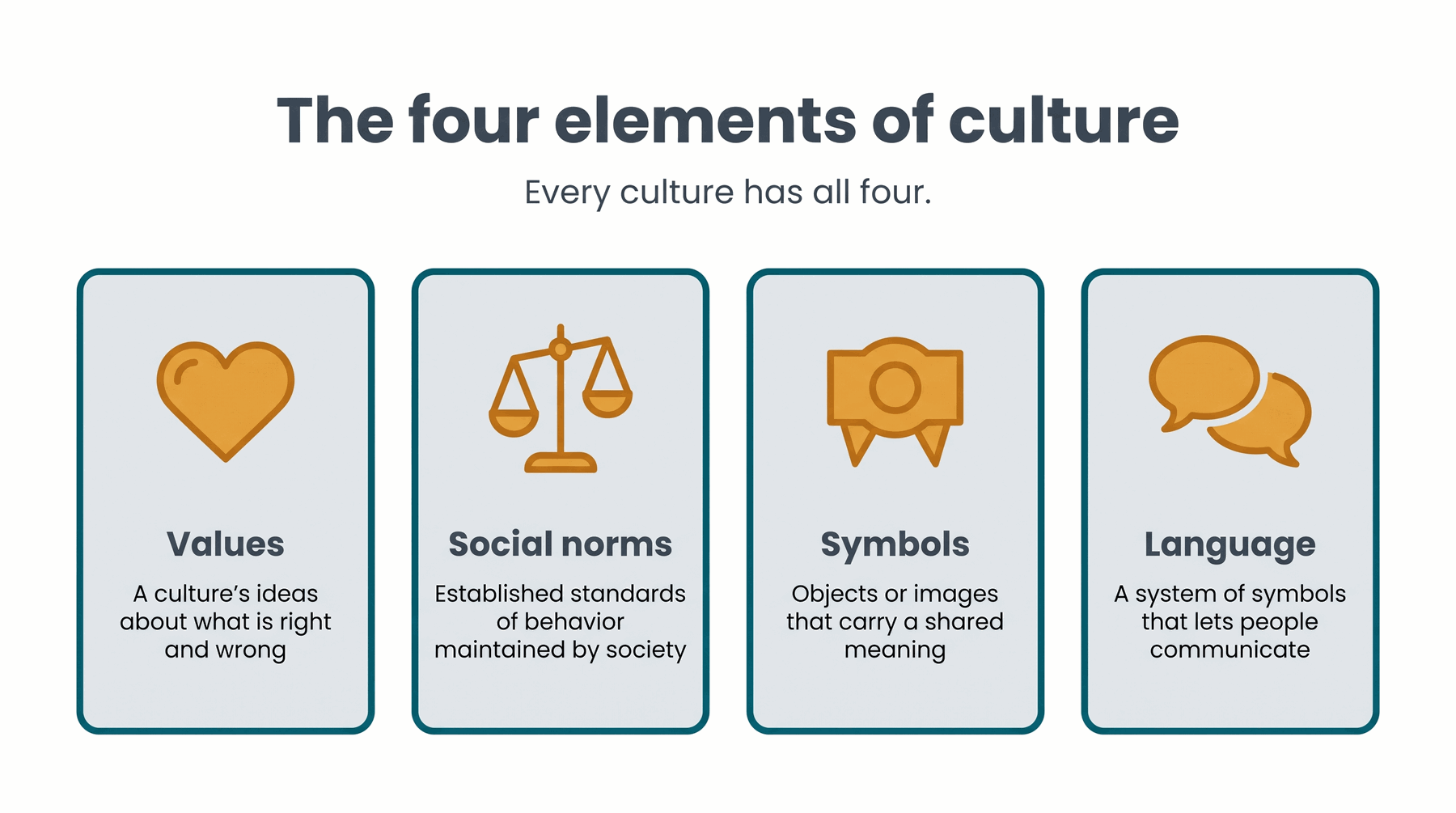
The course is firm that culture is universal — every culture contains all four of these elements. This is the single most likely thing on the quiz to be asked as a list.
Click any diagram to open it full-screen.
Four elements, and every culture on Earth has all four. If you only memorize one list from this section, make it this one.
What this group thinks is right and wrong. American examples the lesson gives: democracy, individualism, freedom of speech.
The lesson's own heading is "Rules That Reinforce Values." Norms run from tiny everyday things (giving up your bus seat) to laws that get enforced. Same idea, different strength.
A cross. A crescent moon. The little figure on a restroom door. A handshake. Anything that carries a meaning that people in the culture all recognize.
Words are symbols too. Language is what you get when you have a whole organized set of them that can be combined to communicate any thought. That's why language is its own element even though it's made of symbols.
Symbols, Values & Norms — Crash Course Sociology #10 — Covers your four elements really clearly. It also talks about "material vs non-material culture" — that's not in your course, so let it wash over you.
Your family thinks birthdays matter a lot, so everyone always shows up to the dinner. Which part is the value and which is the norm?
The value is believing that birthdays and family matter. The norm is the actual expected behavior — everybody turns up to the dinner. Belief first, behavior second.
Got it now? Scroll back up and re-read the section — it should land differently.
Lesson 1.2.3 p4
Acculturation is the process of adopting the social patterns of another group. The lesson's plain-English gloss: "it's fitting in."
The worked example is Matoaka — daughter of Chief Powhatan, better known by her nickname Pocahontas. After marrying John Rolfe she changed her name to Rebecca Rolfe, moved to England, spoke English instead of Algonquian, and traded deerskin clothing for woven cloth. She acculturated to her husband's group.
Why the course cares: watching how people change when they move between groups is a method — it reveals what a group believes and how it behaves.
Lesson 1.2.3 p5
These three sit close together and the difference is who is doing the rejecting.
• Deviance — departure from established norms. The lesson frames it as the group defining itself by declaring what it is not. All societies reject some people, beliefs or behaviors, and who gets rejected changes over time.
• Counterculture — a group systematically opposed to the dominant culture. Here the group does the rejecting, on purpose: "intentional deviation from the social norms of the dominant culture results in the formation of a counterculture."
• Subculture — a group that ignores some of the larger society's values to focus on what it finds important. Not opposed — just differently focused.
The course's examples of countercultures: Students for a Democratic Society (the 1962 Port Huron Statement), the Beat poets (Ginsberg's "Howl"), and the Amish.
Three words that sound similar and get mixed up constantly. There's one question that sorts them every time.
Deviance — society rejects the person or behavior for stepping outside the norms. The pressure points inward, at the individual.
Counterculture — the group rejects society, deliberately and as a group. The pressure points outward, at the mainstream.
Counterculture is actively against the mainstream — it defines itself by the argument. Subculture just ignores some of society's values to focus on its own thing. Not a fight, just a different focus.
Countercultures in your course: Students for a Democratic Society, the Beat poets, and the Amish. Having three named examples ready is worth more than re-reading the definition a fourth time.
The lesson says countercultures are an important part of their larger societies — they challenge issues that are central to that society. It's counterintuitive, which is exactly why it makes a good quiz question.
Cultures, Subcultures, and Countercultures — Crash Course Sociology #11 — Almost exactly this section. It adds "high culture / low culture," which your course doesn't use — ignore that bit.
A group of students at school is really into a kind of music nobody else listens to. They aren't against anything, they just care about their own thing. Counterculture or subculture?
Subculture. They're ignoring part of the mainstream to focus on what matters to them, not systematically opposing it. If they were defining themselves against the mainstream, that would be a counterculture.
Got it now? Scroll back up and re-read the section — it should land differently.
Lesson 1.2.3 p6–8
Page 6 was an animation with an audio track, and it introduced five terms in a row. Your study sheet then asks you to give examples of three of them, so the course clearly expects you to hold on to these.
• Social norms — established standards of behavior maintained by society. Some are actual rules; others are informal.
• Hierarchy — a system that ranks and organizes people into subordinate and superior positions. All cultures contain some notion of hierarchy, even if it's just one leader and everyone else.
• Innovation — new ideas and ways of doing things being introduced and accepted by the group.
• Diffusion — cultural traits spreading from one group to another, usually by migration, trade or communication. As traits diffuse, different cultures start to resemble each other.
• Diversity — differences in cultures, beliefs or behaviors. Note: there's diversity between cultures and also within a single one.
Lesson 1.2.3 p9
Culture shock is the surprise, disorientation, confusion and anxiety of operating inside an entirely different cultural environment from your own. The lesson's scenario: a job moves you halfway around the world, everyone is friendly, but the food, the manners and even the bathrooms are different — and you get overwhelmed.
The lesson draws a conclusion from it: culture shock shows how much power our native culture holds over us. Our beliefs and behaviors are so much a part of us that we may not notice there are other ways to think and act.
It also flips the perspective — Americans find the US ordinary, but immigrants, tourists and international students often find it disorienting.
Culture shock and acculturation always show up near each other, and the quiz will absolutely try to swap them.
Surprise, disorientation, confusion, anxiety. It's what happens to you when you land somewhere that runs on rules you don't know. You don't choose it.
It's what you do next — watching, copying, picking up the new group's patterns until you fit. Matoaka learning English and changing her clothing is acculturation.
If the sentence describes an emotion, it's culture shock. If it describes someone changing how they act, it's acculturation.
Culture shock proves how strong a grip your own culture has on you — your normal is so normal you can't see it until something breaks it.
What is Culture Shock? (Easy Explanation) — Short and plain. Good if the definition's long list of feelings isn't sticking.
What is Acculturation? (Easy Explanation) — The other half of the pair, same channel. Watch them back to back and the difference lands.
Someone moves to a new country. Week one: overwhelmed, can't read the signs, hates the food. Month six: shopping at the local market, using a few phrases, knows how to greet the neighbours. Name each part.
Week one is culture shock — the disorientation and anxiety. Month six is acculturation — actively taking on the new group's social patterns. Shock is the reaction; acculturation is the adjustment.
Got it now? Scroll back up and re-read the section — it should land differently.
Lesson 1.2.4 p1–4
A population is simply the inhabitants of a particular area. But the lesson insists there is more to a population than its size — populations also have population density, average age, and gender ratio.
The course's own comparison makes the density point better than any definition: China has about 1.3 billion people, the world's largest population — but its overall density is much lower than Israel's. Israel has only about 6.5 million people yet is a far more crowded place.
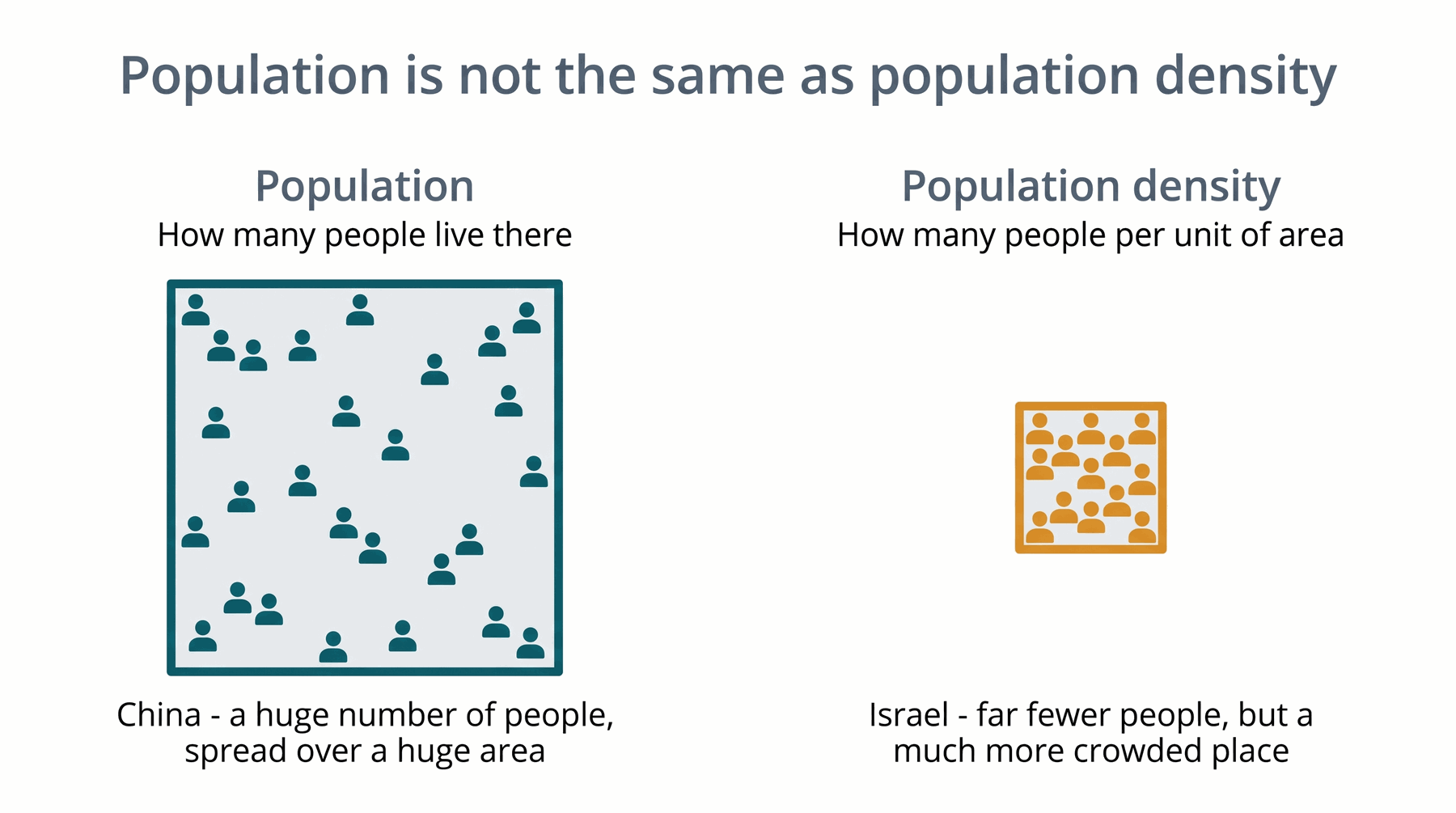
Click any diagram to open it full-screen.
Two pairs of similar-looking words. Both pairs are worth points.
Population = how many people. Density = how many people per unit of area. Elevator with 10 people vs stadium with 10,000: the stadium wins on population, the elevator wins on density.
The course warns these "are often confused" and gave them their own chalkboard, which means it cares. Demography is the subject you study. Demographics are the numbers you get. A demographer does demography and produces demographics.
Demographics ends like statistics — both are data. Demography ends like biology and geology — those are all fields of study.
Your lesson's example: Social Security. Demographers work out how many people will retire and how many workers are needed to pay for it. That's demographic data driving actual government policy.
A researcher spends her career studying how populations change. She publishes a table of average ages by state. Which is demography and which is demographics?
Her field of study is demography. The table of average ages is demographics — the data. Study = demography, data = demographics.
Got it now? Scroll back up and re-read the section — it should land differently.
Lesson 1.2.4 p2 and p5
Your study sheet asks you to draw a population pyramid and explain what it shows, and then to draw two — one society with a rising average age and one with a falling average age. The course delivered this inside a slide show, so it's worth having the picture in front of you.
A population pyramid is a back-to-back bar chart. Age groups run up the middle, youngest at the bottom. Bars go left for males and right for females. The shape is the whole point.
The course's worked example is Canada: between 1971 and 2006 the birthrate fell. The largest group of Canadians used to be teenagers; by 2006 the largest group was in its 40s. Canada had slowly become a middle-aged society.
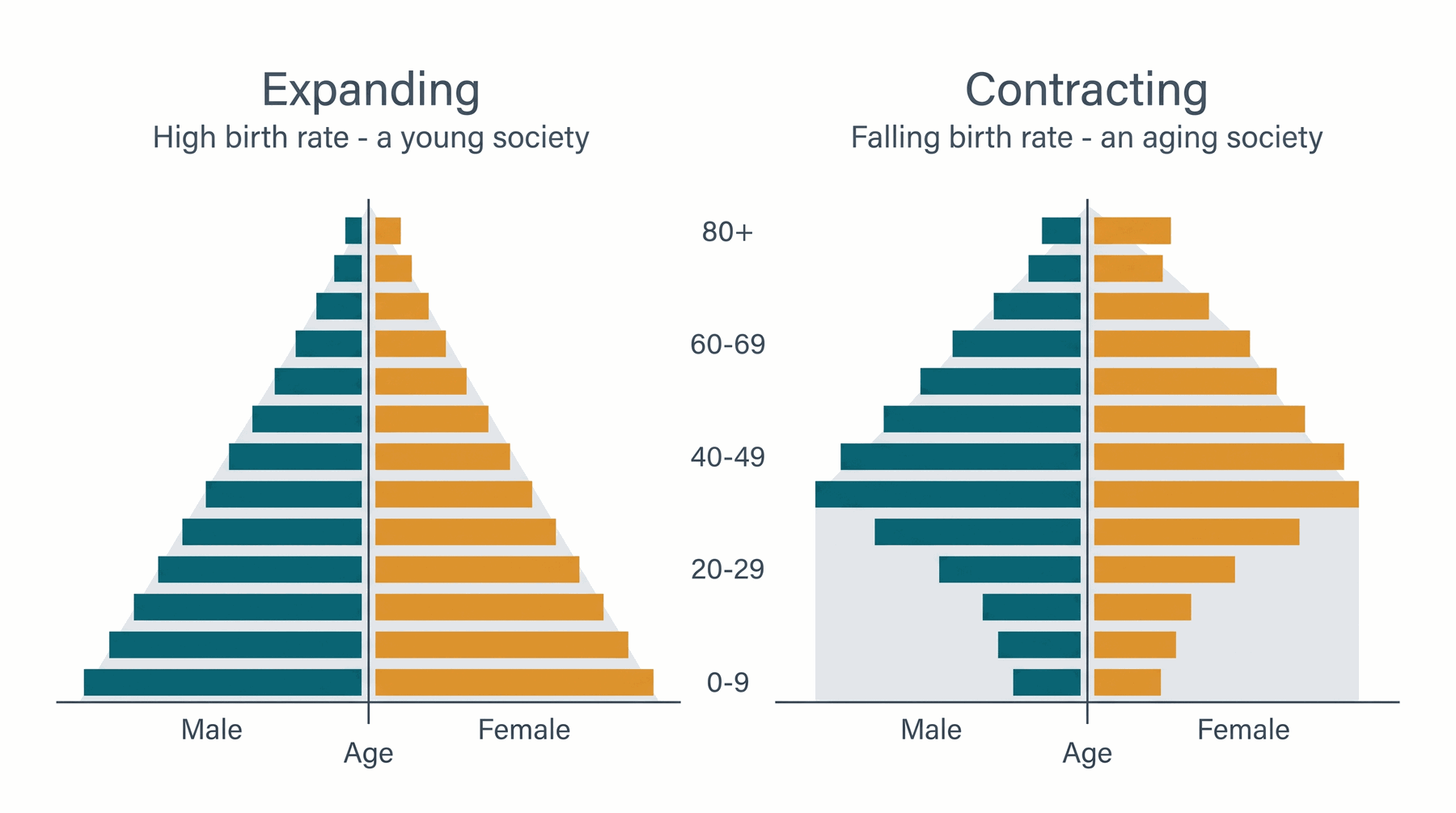
Click any diagram to open it full-screen.
A population pyramid looks confusing for about thirty seconds, then it's easy. It's just two bar charts glued back to back.
The vertical strip up the centre is age, youngest at the bottom, oldest at the top. Every row is one age group — the babies are on the bottom row.
Bars stretch left for males and right for females. Longer bar = more people in that age group. That's the whole reading skill.
Wide at the bottom = lots of babies and kids = high birth rate = a young, growing society. Narrow at the bottom with a bulge higher up = fewer babies = an aging society, where the average age is climbing.
It asks for one society with an increasing average age and one decreasing. Increasing average age = narrow base, top-heavy. Decreasing average age = wide base, triangle. Sketch both and label which is which — that's the whole answer.
1971 the biggest group was teenagers; 2006 the biggest group was in its 40s. The bulge stayed the same people and just moved up the chart, because fewer babies were being born underneath it. That's a falling birth rate, and it's the course's own conclusion.
How to Read a Population Pyramid — Mr Gedge's Geography Channel — Straightforward walkthrough of the reading skill. Start here if the chart itself is the confusing part.
How to Analyze Population Pyramids! — Mr. Sinn — Goes further into shapes and what they mean. More than your quiz needs, but useful if you want the shapes to really stick.
You're shown a pyramid with a very narrow bottom and a wide bulge around ages 45-60. Is the average age rising or falling, and what's happening to the birth rate?
The average age is rising and the birth rate is falling. Few young people at the bottom means fewer babies are being born, so the big middle-aged group keeps drifting upward — exactly what happened in Canada between 1971 and 2006.
Got it now? Scroll back up and re-read the section — it should land differently.
Tick these off before you open the quiz. Saved in this browser.
Built from lessons 1.2.0 Spatial Thinking, 1.2.1 Mental Maps, 1.2.2 Your Mental Map, 1.2.3 Defining Culture, 1.2.4 Population and Demography and 1.2.5 Your Starting Point — including the study-sheet questions from her geographer's notebook.